
Key takeaways.
- Focus on one clear target behaviour rather than trying to change too much at once.
- Explore the underlying reasons why the current behaviour is happening.
- Use behavioural science frameworks such as COM-B and the Behaviour Change Wheel to shape effective interventions.
- Prioritise the activities most likely to influence behaviour and generate measurable results.
- Connect learning outcomes to tangible performance measures wherever possible.
Why behaviour change interventions matter more than ever.
The demand for impact/efficacy-based learning interventions is on the rise, which means organisations are looking more closely at how behaviour change interventions can deliver measurable results.
Return on Investment (ROI) for learning has long been a source of conversation in L&D. Now, with even more data at our fingertips, combined with the economic downturn, we’re looking for learning to ‘move the needle’ more than ever.
Demonstrating behaviour change.
A September 2023 report from the Fosway Group found that only 26% of the 427 CHROs, Talent & L&D Directors, Managers and Learning, Talent & HR Technology professionals surveyed often measure learning outcomes, impact, and success, despite the increasing demands for this kind of data.
ROI is infamously difficult to scientifically calculate within our industry, with many other factors impacting or skewing the figures. There are numerous publications on the topic, many of which sound good in theory, but, when it comes down to it, there’s always one question at the heart of the problem: how can you prove learning will change behaviours, mindsets, or even cultures?
From the outset, the obvious and rather disappointing answer is simple, you can’t – not absolutely. There are, however, a few steps that can be taken to ensure that behaviours are not only changed but that they have been changed in a way that can be measured and articulated.
At Sponge, this connection between learning, behavioural science and measurable outcomes sits at the heart of designing experiences that create meaningful change.
A pragmatic approach to changing behaviours.
Strategising behaviour change demands a prudent, data-backed approach. Our task, as L&D professionals, involves not an abstract contemplation but the application of scientifically validated techniques, fostering a higher likelihood of resonating with and influencing our audience effectively.
Susan Michie’s Behaviour Change Taxonomy, building on the COM-B model, underscores that learners require three core elements:
- Capability: Can this behaviour be accomplished in principle?
- Opportunity: Do opportunities exist, or can they be created, to support the application of this behaviour?
- Motivation: Is there sufficient motivation for the behaviour to occur, and how can we create motivation if it doesn't already exist?
However, the biggest challenge here is identifying the ‘right’ target behaviour.

Making sure the right behaviour change is targeted.
Examining the root causes or underlying motivations for desired actions enables us to ascertain the genuine behaviour we seek to transform and is a vital step in effectively changing behaviours.
For more on the barriers between knowing what to do and actually doing it, explore Sponge’s podcast on changing behaviours with Julie Dirksen.
Looking beyond the surface behaviour.
For example, imagine we are trying to improve compliance at an organisation. Our first instinct may be to implement a compliance learning experience outlining policy and legislation in the hope that once employees have completed that training, they will alter their behaviour to be more compliant with their organisation’s policies.
However, this surface level approach fails to consider the ‘why’ behind the lack of adherence. Perhaps the original non-compliance was genuinely borne out of a lack of awareness of policies and procedures... or is the behaviour we’re looking to change actually created by the need to save time and cut corners due to poor project management skills.
Digging deeper to find the true target behaviour.
In any case, L&D teams need to be prepared to dig further into the behaviours at hand. By digging deeper, the ideal target of the learning being designed can be clearly identified. This same principle applies when choosing the right custom learning partner, where understanding the business problem and desired behaviours should come before deciding on the learning solution.
If the result required is increased compliance but the lack of compliance comes from the need to save time due to poor project management, then the learning being put in place needs to address both elements.
This is why Sponge’s approach to behaviour change focuses on understanding what is driving current behaviours before designing learning experiences intended to shift them.
Choosing the right intervention ingredients.
After establishing the true behaviour for change, determining the necessary adjustments becomes relatively straightforward. However, deciphering which “ingredients” or strategies will effectively elicit that change can present a further challenge.
It becomes pivotal to distill our focus onto essential targets, thereby utilising those strategies that are anticipated to garner the most impactful results, rather than diluting efforts across too many variables.
The Behaviour Change Wheel is an invaluable tool for pinpointing the ‘ingredients’ that will be most effective in actioning this behaviour change and can be simplified into a four-question process:
- What behaviour are we trying to change?
- What will it take to bring about the desire change?
- What type of broad intervention approaches might be relevant?
- What specific components should my intervention involve?

Focus your efforts on the behaviours that matter the most.
It can become overwhelming trying to analyse all the potential factors that could influence the desired behavior change. While all these factors might push you closer to that elusive change, not all of them will carry the same weight, meaning it's crucial to concentrate your efforts on key targets.
By prioritising the factors we expect to have the most significant impact, we can maximise our effectiveness rather than spreading ourselves too thin and diluting our efforts. Focusing on key behaviours allows more effective allocation of resources, ensuring they’re directed where they’ll have the most significant impact.
Moreover, homing in on key behaviors creates a more straightforward path for evaluation. Changes in specific behaviors are easier to track and can be more clearly linked to tangible financial or performance metrics. For a practical example of how learner data can be used to measure effectiveness and support better decision-making, explore Sponge’s Lundbeck case study.
Sponge combines behavioural science, learning design and measurement to help organisations create experiences that support the adoption and reinforcement of new behaviours.
Conclusion.
Dissecting behaviour into its integral components is an incredibly effective way to bolster our ability to enhance and substantiate ROI, providing a clearer trajectory of its origins.
This can be broken down into four key points that, when kept in mind while creating and delivering learning, will help you to affect behaviour change that works for your learners and organisation alike:
- Make sure you know your one true target behaviour.
- Take time to explore all intervention ingredients that could change that behaviour.
- Answer all the questions in the behaviour change wheel process.
- Focus on the activities that will most impact the behaviour change you’re looking to shift.
With these in mind, you can continue to strive for impactful ‘showstopper’ learning interventions that make a difference.
Chloé
Priestley.
Chloé Priestley brings over 16 years of rich experience in the Learning and Development industry. With a journey spanning back to 2007, she has occupied many roles, from facilitator to content designer. At Sponge, Chloé leverages her hands-on expertise in her role as a Learning Experience Consultant to assist global enterprises in shaping their learning strategies and devising innovative solutions for sustainable transformation.

Measuring impact
- with Kevin Yates.
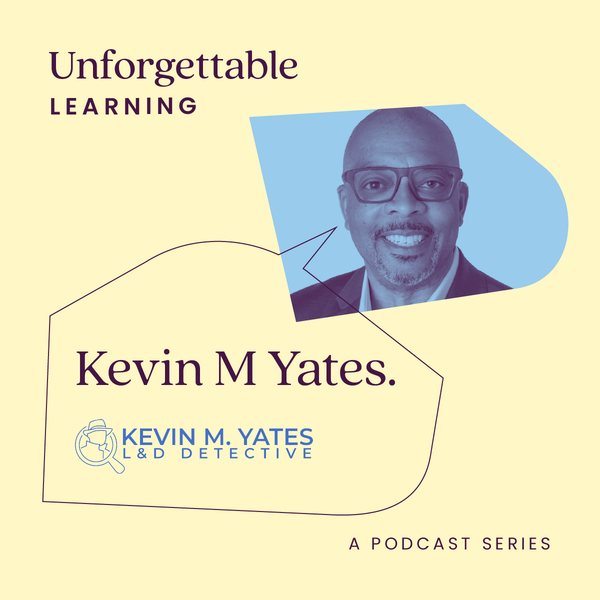
In episode five of The Unforgettable Learning Podcast, we speak to Kevin Yates, the L&D Detective, about all things impact measurement. Tune in to the podcast to hear L&D's own Sherlock Holmes discuss key points for getting past the difficulty inherent in measuring impact in L&D and outline the questions L&D leaders should be asking to ensure they’re designing intentionally for impact.
Speak to our experts on behaviour change.
Fill in the form to get in touch and contact our learning experts today.